
On Being Bad
And how to be bad is to begin.

For your listening pleasure during this read.
What does it mean to be bad? Of course, it depends on how you use the word. It's first a moral judgment. But it can also mean someone who’s super cool—a bad bitch, if you will—which arguably still stems from the moral judgment: someone who doesn’t care about breaking the rules.
Lately, I've been chewing on how being bad at any activity is freeing. How taking the weight away from the term or phrase, even self-identifying with it, gives the middle finger to perfectionism and can open the door to so many opportunities in my life. Think of all the things I can be bad at, if I let myself be bad!
Think of all the things I can be bad at, if I let myself be bad.
And here’s the thing: being bad at something at first is a prerequisite for most of us. We wish or are under some delusion that there’s some special thing we haven’t found yet in the world where we will not be bad at it at first, but most of us are wrong. If you’re reading this and not already considered a savant at something, that’s probably you. It's as inevitable as death that incompetency precedes competency, but I don't think we ever are really allowed to let that sink in, given *points at the world and societies we find ourselves in, depending on when or where you’re reading this from*.
So, I’ve been trying to build a practice around being bad at shit.
For one, I got roller skates. I don’t practice in them. But when I need them for an event or some exercise, I have made it my prerogative to use them. They’re there, waiting for me. I bought them to be bad at them.
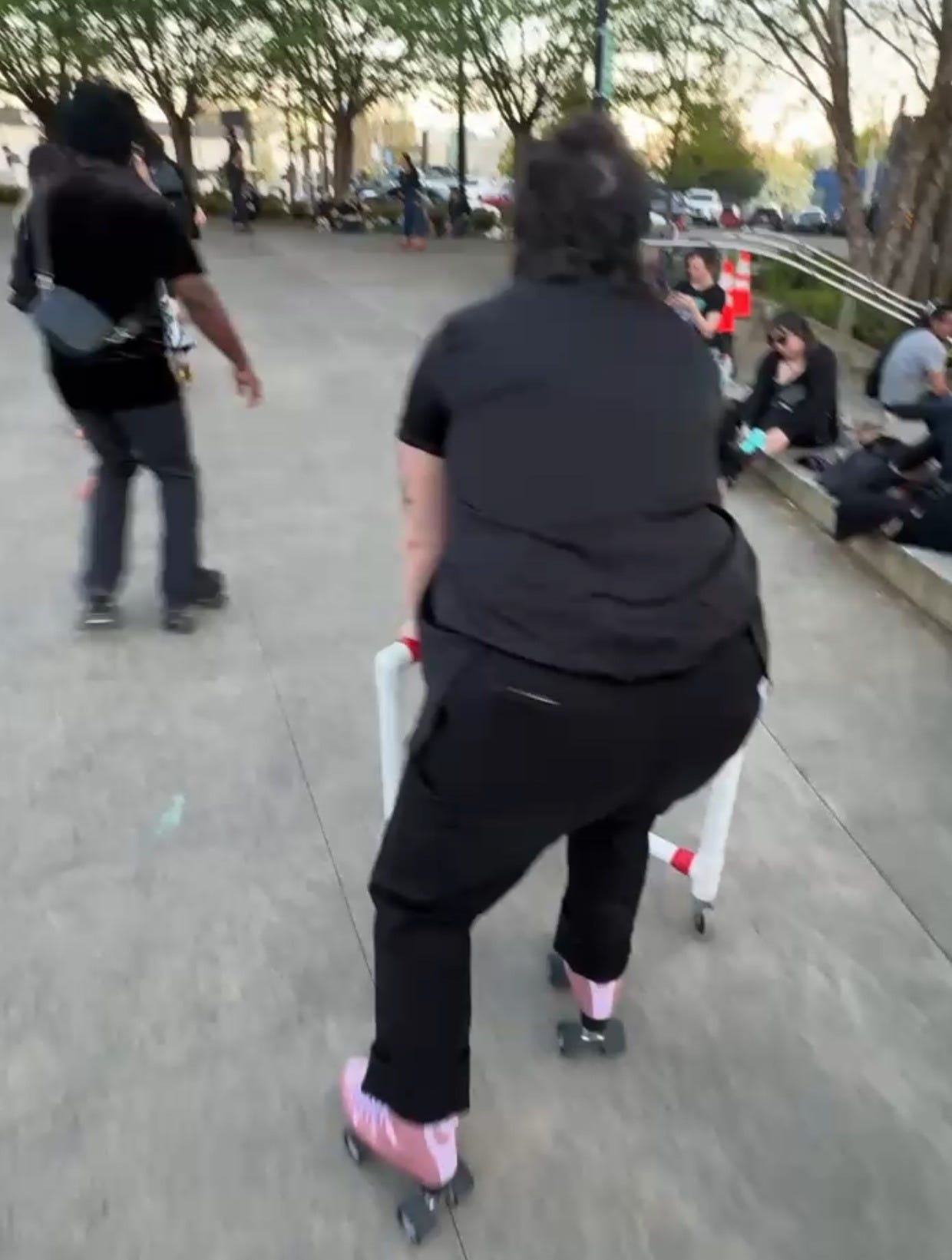
I bought them to be bad at them.
And truly, I'm bad at it. I went to an event recently in Portland where there were tons of people and they had four or five of these tiny rickety walkers built for kids learning to skate, and I unabashedly used one the entire time (much to the dismay of my lower back, since I really had to stoop to make use of it).
But to be honest, I was only unabashed about it after about 10 minutes of sitting on the sidelines embarrassed and alone, though. My friends went around the circle skating and laughing several times before they got a walker for me and forced me out into it. Before that, I was in perfectionism brain, worrying about what everyone thought of me, feeling like a failure, so much so that I almost took my skates off and decided to be a spectator. (This is how wretched things are in my head 70% of the time, by the way.) But in my new practice, the practice of being bad, I am finding a new way to live.
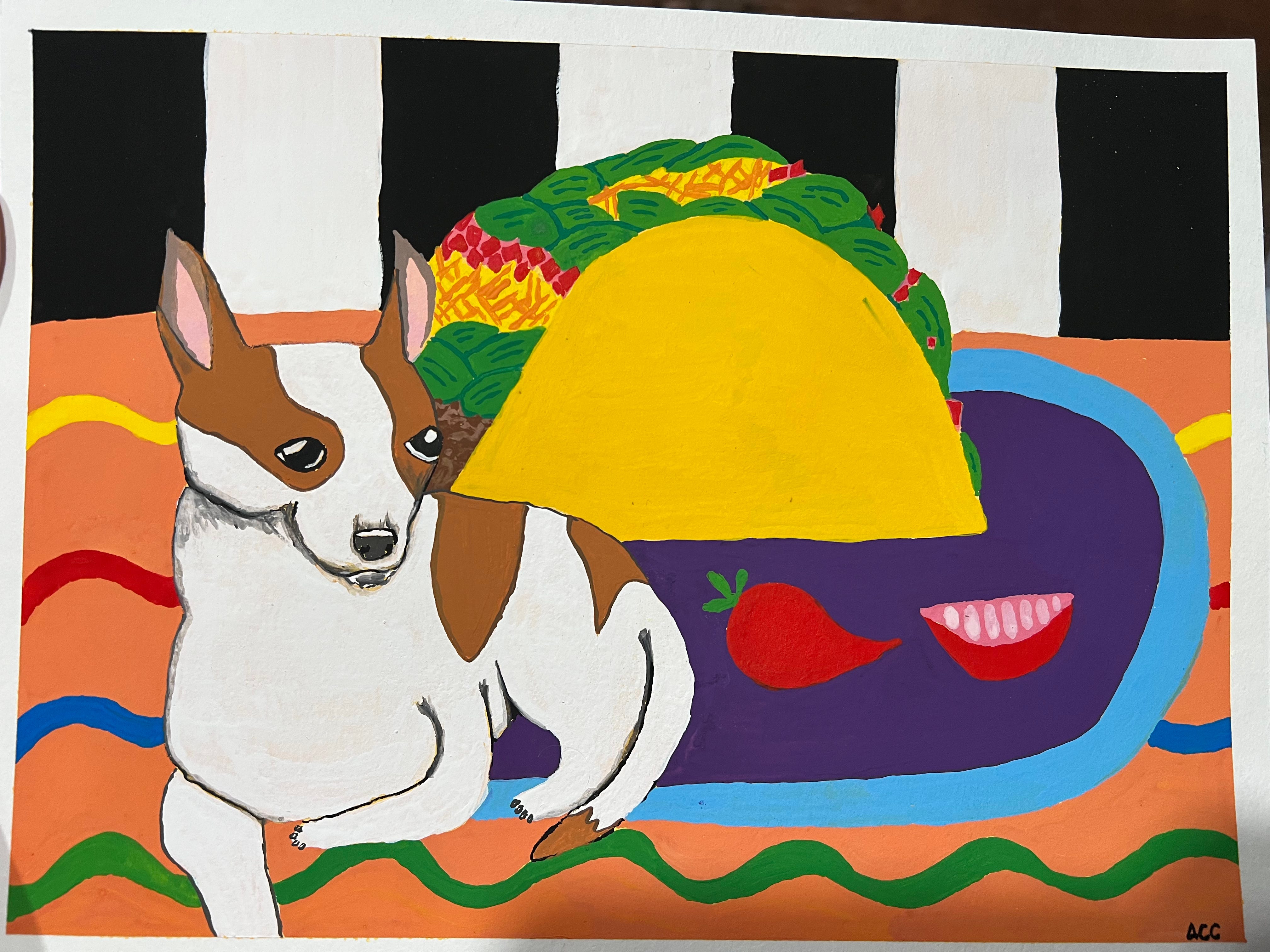
Another example is painting. I've been painting fairly regularly now for years. Have never taken a class. Here and there, I'll YouTube 30 seconds of a video if I want to know how to do something, but I'm really impatient and sporadic about it. I'm still bad at it, objectively, after what many would consider quite a bit of time of practice. But somehow I've reached a place where I am more than okay with it.
And can you guess how I feel about painting? It's one of my greatest joys.
When I say I'm bad at something, people inevitably tell me the contrary, and some of them mean it (they like my style) but some of them are trying to soothe me. But I don't need soothing. This is the power in acceptance of one's art, and ownership of one’s experience.
One of my favorite adages about art is that you always start out having better taste than you have ability. And the fact that you have good taste? That’s important.
You always start out having better taste than you have ability. And the fact that you have good taste? That’s important.
But what's really frustrating about learning a new artform or anything new, really, is that you cannot match your taste at first, so you are constantly disappointed. The only way out of that is to continue practicing, trying— to essentially sit in the disappointment you have in yourself, and share yourself anyway. It is living with the self that is vulnerable, that is unskilled, that is trying, that, to you, is not succeeding.
Yikes.
I began my career as a poet trite, occasionally offensive, and genuinely not aligned with my taste. These days, I still do not match my own taste very often, but I'm a lot closer. I’ve actually achieved it more than once. And what I've cultivated is a genuine appreciation for my bad earlier work, and my bad work now (yes, yes, blah blah, my bad work and your bad work could be somebody else's treasure), because it taught me my own standards and cultivated a courage to sit with and, in some cases, share myself at my least refined. It has given me a new prism with which to look through badness itself.
Badness is not objective, nor is it purely subjective (much like anything). But a good guidepost is one’s own taste. As I was frantically trying to ease my anxiety about being bad at my new job last week, I came across a really helpful chart that speaks to the stages people go through with newness:
Unconsciously incompetent
Consciously incompetent
Consciously competent
Unconsciously competent
I’ve started using this framework so much in my life, in my art. I feel consciously competent with writing. Perhaps I’m consciously incompetent with painting. For some things, I want to move up the ladder. For others, I’m quite happy where I’m at, thank you. It takes discernment and, if you want to move along, it takes work.
And anyways, I want to rewrite the script, perhaps, or lift the veil off the very taxonomy we use for the things we choose to do with our lives. I want to be able to be bad.
I want to rewrite the script— or lift the veil— off the very taxonomy we use for the things we choose to do with our lives.
I am building this space to encourage others to have their own practice in badness. It's a double entendre, because if someone is a bad bitch, that means they're pretty damn cool. So for me, the way to become bad (positive) is to understand and accept the bad (negative). Or maybe to not qualify it at all.
This week, I encourage you to explore your own taste in relation to your ability at your favorite project, artform, or life skill that you want to move forward in competency with. I know everyone says not to compare yourself to others and, like, don’t do that unhealthily or whatever, but find something you truly love— a poem, a painting, a skateboarder, and flutist— and hold it in the light in comparison to your latest work. This isn’t a practice in self-flagellation; it’s a study. Treat it, and yourself, with the curiousity and kindness of study. Find the differences and similarities. Write them down. These will guide you.
I’ll use my writing as an example, since I feel consciously competent at it.
Here are a few things I observed early on in my own writing compared to the things I loved:
– Clichés and overwrought turns of phrase were everywhere. They came easily, but weren’t inventive. I like work that surprises me.
– I wrote too universally. The more specific a poem got, the more moving the work became.
– I over-explained. The writing I admired said so much with so little.
What’s to your taste may differ, and your mileage may vary (see the cliche? Idk, it still slaps IMO). (And just so you’re aware, I think this post is bad and I’m posting it anyway, so THERE.)
Give it a try, and please comment your thoughts and let me know where your exploration leads you.
Remember, as the great Mary Oliver once said, “You do not have to be good.”
And so the great Abhainn Connolly said,
“Come on then, let’s be bad.”